

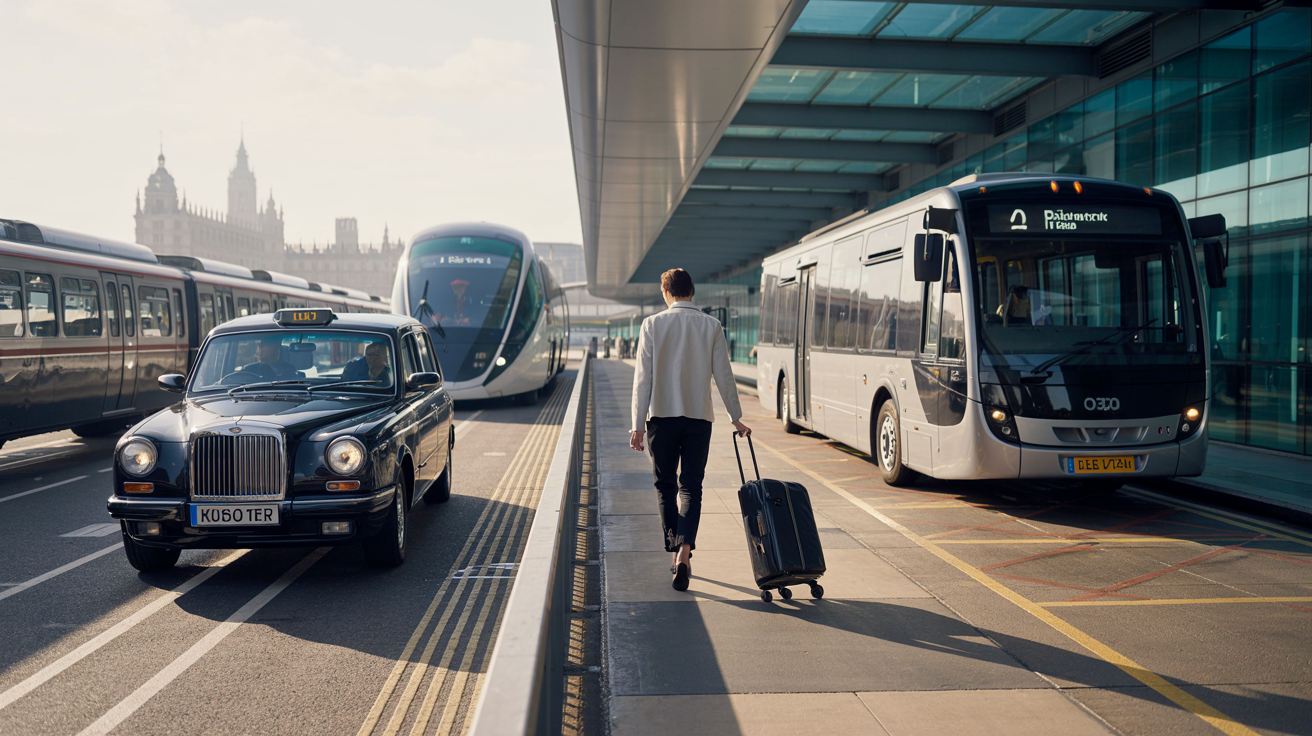
Landing in London for the first time (or the fifteenth) always comes with the same little puzzle: you’ve made it through customs, you’re standing in arrivals with your bags, and now you actually have to get into the city. London has six airports serving it, and every single one has a slightly different answer to “what’s the best way in.” Here’s how the main options stack up, so you can pick the one that actually suits your trip rather than just grabbing whatever’s closest to the door.
1. The Express Trains: Fast, But Not Always Door-to-Door
If your hotel is near a major station and you’re travelling light, the dedicated airport express trains are hard to beat. The Heathrow Express gets you into Paddington in 15 minutes flat, the Gatwick Express does Victoria in half an hour, and the Stansted Express covers a much longer distance to Liverpool Street in under 50 minutes. They’re frequent, they run well into the night, and unlike literally every other option on this list, they’re completely unaffected by traffic.
The catch is the word “express,” you’re paying a bit more for that speed compared to the slower regional trains that stop at the same stations, and once you arrive, you’re still on your own for the last stretch to your actual hotel. Fine if you’re comfortable with the Underground and travelling light. Less fun with three suitcases and a toddler.
2. A Pre-Booked Private Transfer: The One We’d Recommend If You’re Tired
This is genuinely the option we lean toward after a long-haul flight, especially landing somewhere unfamiliar for the first time. You book it before you fly, the price is agreed upfront so there’s no meter ticking away in traffic, and your driver is standing in arrivals with your name on a board rather than you wandering around trying to find a taxi rank.
The bigger advantage most people don’t think about until it happens to them: flight delays. If your plane sits on the tarmac for an extra hour, most pre-booked services track your flight and simply adjust, no extra charge, no awkward phone call trying to explain you’re running late. We’ve booked an airport transfer a few times now specifically for early-morning departures, when public transport is running on a reduced schedule and the last thing you want is uncertainty about whether your ride will actually be there.
It costs more than the train, there’s no getting around that, but split across two or three people it often lands close to what you’d pay for the same number of train tickets, minus the stress.
3. Ride-Hailing Apps: Convenient, But Watch the Timing
Uber, Bolt and similar apps work well at every London airport, and for a lot of shorter hops, particularly from London City given how close it sits to the centre, they’re genuinely one of the cheapest options going. You know the driver’s name, the car, and roughly what you’ll pay before you commit.
The “roughly” is doing some work in that sentence. Prices swing hard with demand, and airport pickup times are exactly when demand spikes hardest, early mornings, Friday evenings, and any time flights get delayed and a wave of tired travellers hits the arrivals hall at once. We’ve seen quoted fares more than double during a bad surge window. If you’re set on using a ride-hailing app for an airport run, booking ahead specifically to lock in a price before that happens is worth doing, rather than hailing one cold at the terminal and hoping for the best.
4. Black Cabs: The Classic, at a Classic Price
There’s something to be said for just walking up to a taxi rank, hopping in, and letting a driver who’s done “The Knowledge” (London cabbies genuinely have to pass an exam on the entire city’s street layout) take care of the rest. No app, no advance booking, and drivers who generally know shortcuts an app’s GPS wouldn’t suggest.
The trade-off is cost. Black cabs run on a meter, so traffic works directly against your wallet, and they’re consistently the most expensive door-to-door option at every London airport. A handful of airports also add a specific drop-off charge on top, which stacks with whatever the meter reads. Great if you value the experience and don’t mind paying for it. Less great if you’re watching your budget.
5. National Express Coaches: The Budget Champion
If price is genuinely the only thing that matters, the coach wins, full stop. National Express runs services direct from every major London airport straight into central pickup points, no connections needed, and fares can be a fraction of the train or a taxi if you book ahead.
The trade-off is time, and it’s a real one. Where a train might take 30-50 minutes, the equivalent coach journey can run anywhere from 60 to 120 minutes depending on traffic, since you’re sharing the road with everyone else. It’s also the one option on this list that runs genuinely around the clock, which makes it a solid backup for very early or very late flights when trains have stopped running for the night.
So, Which One Should You Actually Pick?
Honestly, it depends on what you’re optimising for on that specific trip. Travelling solo with a backpack and know your way around the Tube? The express train is fast and simple. Landed after a 12-hour flight with the whole family and a mountain of luggage? A pre-booked private transfer takes the guesswork out of the whole thing. Just need to get somewhere close and cheaply? A ride-hailing app off-peak, or the coach if you’re really counting pounds.
There’s no single right answer for every trip into London, just the right answer for the trip you’re actually taking.
