


You’re walking a narrow lane behind a temple somewhere in Kyoto. The crowds are three streets away. And you stop – not at a landmark, not at a photo spot – but at a crumbling stone wall with moss pushing through the cracks. It’s weathered, uneven, and quietly beautiful in a way you can’t quite explain.
That feeling has a name in Japanese. It’s wabi sabi. And once you know it, you see it everywhere – in the worn step of a 300-year-old inn, in a bowl that’s been repaired with gold, in a painting that seems unfinished but isn’t. This article looks at what wabi sabi painting actually is, why it’s resonating with so many people right now, and how to bring a piece of that quiet beauty home.
What Wabi Sabi Actually Means (And Why It’s Not Just a Design Trend)
The two words mean different things. Wabi points to a humble, simple beauty – the kind found in rough-hewn objects, imperfect natural forms, things that don’t try too hard. Sabi is about time: the beauty that accumulates through age and use, the patina that a thing earns by existing in the world. Together, they describe an aesthetic that writer Richard Powell summarized as: “Wabi-sabi nurtures all that is authentic by acknowledging three simple realities: nothing lasts, nothing is finished, and nothing is perfect.”
This isn’t minimalism. Empty rooms are not wabi sabi. Wabi sabi is about honesty in objects – the crack that shows, the edge that’s slightly off, the brushstroke you weren’t supposed to leave in but did. According to Stanford’s Encyclopedia of Philosophy, wabi is the most conspicuous and characteristic feature of traditional Japanese beauty, rooted in 15th-century Zen Buddhism and formalized through the tea ceremony by the master Sen no Rikyu, who deliberately chose rough, misshapen bowls over gilded ones to make a point about what beauty actually is.
A genuine wabi sabi painting doesn’t try to look perfect. It shows the hand that made it – the pressure behind a brushstroke, the area where pigment pooled and dried differently, the corner the artist left breathing instead of filling in.
That’s what gives a wabi sabi painting its depth. The philosophy isn’t in the muted color palette or restrained composition alone. It lives in the intention behind the work, in the acceptance of imperfection, and in the visible presence of the artist’s hand.
How Wabi Sabi Shows Up in Painting
Visual language matters here, so it’s worth knowing what to look for.
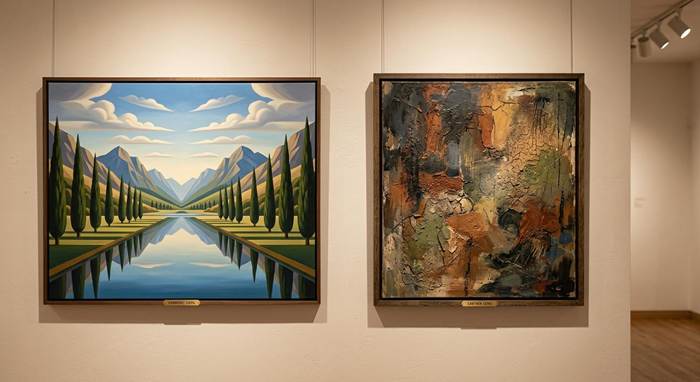
Wabi sabi paintings tend to use asymmetry deliberately – a Japanese principle called Fukinsei. Nothing is centered perfectly. The composition has weight on one side, or a figure placed near an edge, or a horizon that drifts. Your eye moves, pauses, and finds its own way. The palette runs toward earthy tones: beige, clay, weathered grey, moss green, the color of oxidized metal in old light. These aren’t accident – they echo the natural materials at the heart of the philosophy.
Texture is another tell. In a wabi sabi painting, rough and smooth areas coexist. A rough section creates movement; a smoother area gives the eye somewhere to rest. Edges are sometimes left unfinished. Pigment pools where it wants to. The marks of process stay visible rather than being sanded down into a polished surface.
Contrast that with Western academic painting, where the goal has often been precise geometry, a flawless finish, and the removal of any evidence that a human hand was involved. Wabi sabi runs in the opposite direction. The hand is the point.
The roots go back to the Momoyama period in Japan. Iga and Raku ceramic wares – made for the tea ceremony, deliberately uneven and fire-marked – are the visual ancestors of this approach. So is kintsugi, the practice of repairing broken pottery with gold lacquer, which treats fractures as part of an object’s history rather than defects to hide. The Stanford Encyclopedia of Philosophy’s entry on Japanese aesthetics traces this lineage in depth, and the Connecticut College academic exhibition on wabi sabi ceramics documents the ceramic tradition specifically – both worth reading if you want the historical depth behind the aesthetic.
Why Wabi Sabi Is Having a Moment Right Now
It’s not a new idea. Leonard Koren published “Wabi-Sabi for Artists, Designers, Poets & Philosophers” in 1994, which introduced the concept to Western audiences. It just took about 30 years to hit the mainstream hard.
The Depositphotos “Creative Trends 2025: Elevated Perspectives” report named wabi sabi one of seven top creative trends shaping the year, placing it under the category “Crafted harmony” – traditional art forms reclaiming relevance in what the report described as a digitally saturated market. According to 2025 trend data from global design agencies, searches for “wabi sabi wall decor” surged by 90%. That’s not interior decorating noise. That’s a cultural shift.
Michaels’ 2026 Creativity Trend Report was even more specific: it called out oil pastels, plaster art, and mixed-media wabi sabi wall pieces as a defining consumer craft movement, noting that “handmade decor adds depth and personality that mass production can’t replicate.”
People are tired of the algorithm-optimized, perfectly filtered, endlessly smooth surface of digital life. They want something that has texture. Something that shows it was made by a person. Wabi sabi painting fits that need exactly – not because it’s trendy, but because it’s the opposite of trend-driven.
Wabi Sabi and the Traveler’s Mindset
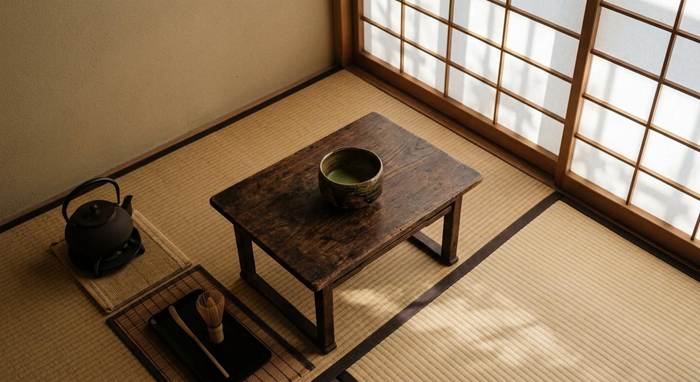
Slow travel and wabi sabi share the same core value: presence over perfection.
The traveler who stops at a crumbling wall instead of pushing on to the next Instagram spot is already practicing wabi sabi without knowing it. They’re not optimizing their itinerary. They’re paying attention.
Japan is seeing this shift in real numbers. According to TravellingWeasels (2025), Japan welcomed over 21 million visitors annually, with a growing segment specifically seeking wabi sabi-inspired experiences – ryokans, moss gardens, pottery workshops, neighborhood walks – over polished tourist routes. Japan’s September 2025 numbers alone hit approximately 3.27 million visitors, a figure that reflects how hard that country is pulling in travelers who want something authentic.
The Japan Promotion Organization presented a dedicated WABI SABI cultural pavilion at Japan Expo Paris, running since 2011, with international media coverage that shows how far this aesthetic has traveled beyond its origins. It isn’t niche anymore. It’s a recognized cultural export.
Design Hotels’ travel guide to wabi sabi Japan describes how ryokans embody the philosophy through tokonoma alcoves, raw timber, unfinished walls, and natural light that shifts through the day. As their guide puts it, a wabi sabi approach to Japan means choosing the forest path over the tourist bus. Staying somewhere quiet. Noticing the bowl your tea came in.
For travelers who follow the “never too old” approach to exploration, this mindset is actually good news. Wabi sabi travel isn’t physically demanding. It’s perceptive. You can do it at any pace, at any age, anywhere. If you’re thinking about hands-on cultural experiences like pottery workshops or gallery visits, look at how those fit into a broader activity plan – the way a well-considered travel activities itinerary can make room for the slower, more intentional moments alongside the bigger sights.
Bringing Wabi Sabi Home: What to Look for in a Painting
After a trip to Kyoto, or a long afternoon in a gallery, you want to take something real home. Not a postcard. Something that carries weight.
The impulse is the same as seeking genuine local craft over a souvenir shop trinket – the difference between a piece that will mean something in ten years and one that won’t. Much like seeking unique cultural gifts on your travels, the trick is knowing what you’re actually looking for.
For wabi sabi painting, here’s what distinguishes the genuine from the imitation:
- Visible hand – You can see how it was made. Brushstrokes aren’t smoothed away. The process is part of the piece.
- Organic asymmetry – Nothing is perfectly centered. The composition breathes.
- A muted natural palette – Earthy tones, not bright saturated color. Think clay, weathered wood, pale sky, aged paper.
- Texture that invites touch – Whether through layered paint, mixed media, or raw paper, there’s physical depth.
What to avoid: mass-produced prints that copy the muted palette without the intent, overly symmetrical compositions sold as “wabi sabi-inspired,” synthetic tones trying to pass as earthy. The global handicrafts market was estimated at $739.95 billion in 2024 and is projected to grow at a 4.9% CAGR through 2030 (Grand View Research), which means the market is huge – but most of that volume isn’t genuinely handmade. Knowing what separates craft from copy matters when you’re spending money on something you intend to live with.
The good news: wabi sabi art doesn’t need a designed interior to work. It wants natural materials around it – raw wood, stone, linen – but it doesn’t need a matching set, a gallery wall, or a decorator’s plan. It’s better alone. Shifting how you think about what belongs in your home is a bit like the mindset shift that makes better travelers too – once you stop chasing the perfect and start noticing what’s actually there, everything looks different. It’s the same instinct that shapes the best approach to any destination, whether that’s a practical perspective on traveling through Italy or a weekend in a ryokan you didn’t plan too carefully.
The Crack in the Cup Is the Whole Point
That crumbling wall you stopped at. That worn step. That bowl with the gold seam running through where it broke and was put back together – those are the moments that make a trip worth taking.
Wabi sabi painting is a way to hold onto that feeling once you’re home. Not as a souvenir, but as a daily reminder that the things worth paying attention to are rarely the polished ones. The best piece you’ll ever buy won’t be perfect. That’s exactly why it’ll still mean something in twenty years.
