

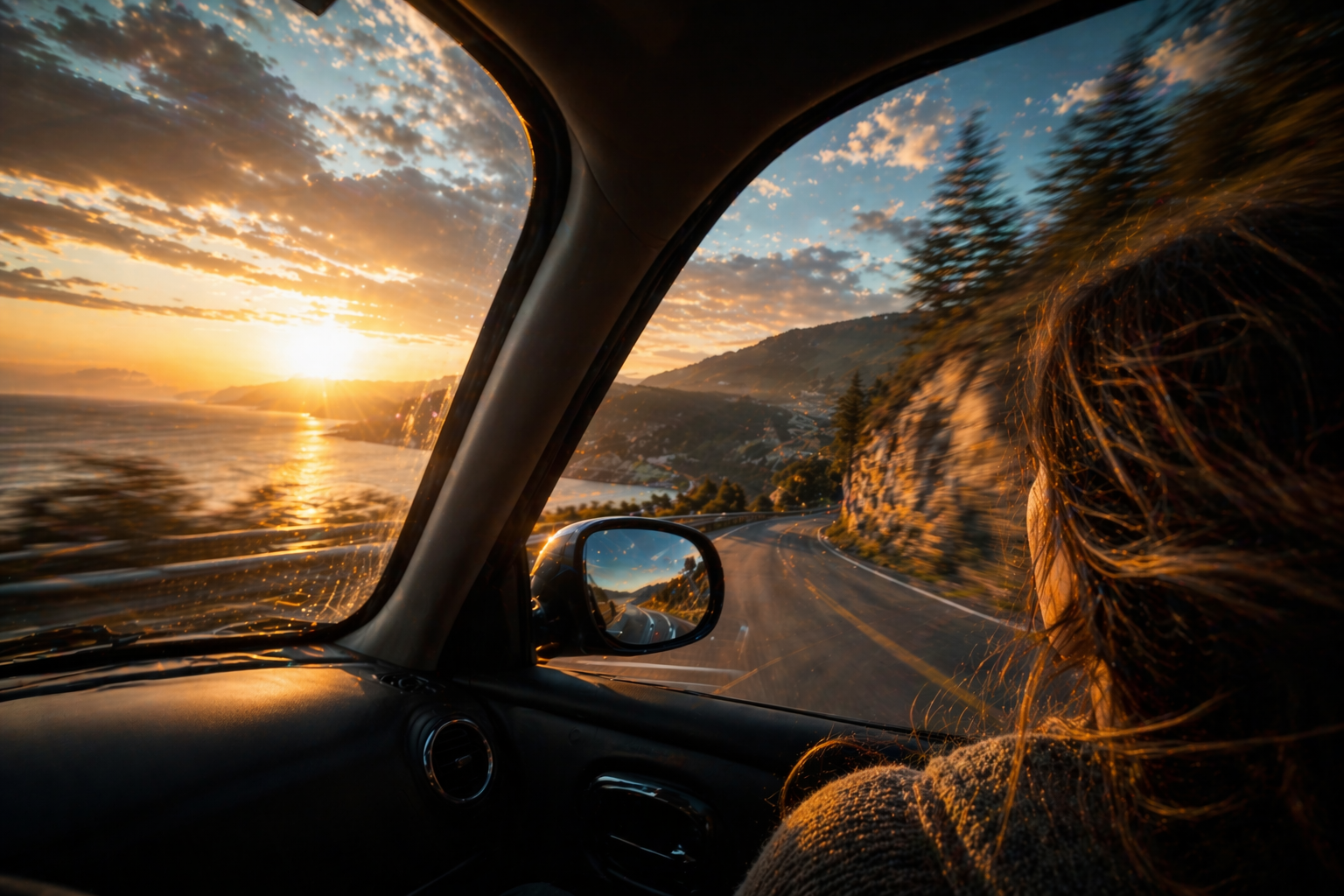
There is a distinct way the world appears when seen from a moving vehicle. It is not quite the same as walking through it, nor is it comparable to viewing it from a fixed position. Travel in motion creates its own visual language—one shaped by speed, framing, and the constant reorganisation of attention.
From the inside of a car, landscapes are not static scenes but passing sequences. Buildings stretch and compress, trees blur into rhythm, and everyday details gain or lose significance depending on how quickly they enter and leave the frame. This shifting perspective is part of what makes road travel psychologically and visually unique.
The Windshield as a Moving Frame
A car windscreen is more than a protective barrier—it functions like a constantly updating frame. Unlike a photograph or a window in a building, it does not hold a single view. Instead, it continuously redefines what is worth seeing.
At higher speeds, the visual field narrows. The brain prioritises motion, contrast, and large shapes over fine detail. Road signs become more prominent, while textures in the environment fade into background noise. At slower speeds, especially in towns or rural areas, detail returns: architecture, people, shopfronts, and small environmental cues re-enter awareness.
This dynamic filtering shapes how journeys feel. Motorways often feel abstract and meditative, while slower roads feel more observational and intimate.
Wheels as a Measure of Time
One of the less obvious effects of travel in motion is how it alters the perception of time. Inside a moving vehicle, time is not experienced as a fixed sequence but as distance being converted into moments.
Milestones—junctions, bridges, roundabouts, service stations—become temporal markers. Instead of measuring time in minutes alone, drivers begin to think in segments of road. “After the next exit” or “just past the viaduct” becomes a way of organising experience.
This creates a layered sense of time. The present moment is always slightly ahead of where you are physically located, shaped by anticipation as much as observation.
The Psychology of Passing Landscapes
The human brain is not naturally adapted to sustained high-speed visual change. Yet over time, it learns to process it efficiently.
Passing landscapes create a phenomenon known as selective attention. The mind does not attempt to absorb everything; instead, it builds a simplified model of the environment. Repetitive elements—fields, hedgerows, signage—fade into a kind of visual shorthand, while unusual features momentarily stand out.
This is why certain journeys feel memorable even when large portions of them are visually similar. The brain anchors memory to contrast rather than continuity.
Weather, Light, and Emotional Tone
Few environments change as quickly as those viewed through a car window in motion. Weather, in particular, transforms the emotional tone of a journey in real time.
Sunlight breaking through clouds can dramatically alter perception, making familiar roads feel unfamiliar or newly significant. Rain, by contrast, softens detail and reduces contrast, creating a more enclosed, introspective feeling inside the vehicle.
Even the angle of light during different times of day shapes mood. Early morning travel often feels clearer and more structured, while evening journeys tend to feel more reflective, with longer shadows and reduced visual sharpness.
These shifts are subtle, but they contribute heavily to the emotional texture of travel.
The Quiet Role of the Vehicle Interior
While attention is drawn outward, the interior of the vehicle plays an equally important role in shaping perception.
The cabin acts as a controlled sensory environment. Sound is filtered, temperature is stabilised, and movement is regulated through suspension systems designed to smooth irregularities in the road. This creates a contrast between internal stability and external change.
That contrast is part of what makes road travel feel immersive. The outside world moves rapidly, while the inside remains comparatively still. The mind operates within that balance, oscillating between observation and comfort.
Even small details—seat positioning, dashboard layout, ambient noise—contribute to how the outside world is interpreted. The car becomes a kind of perceptual filter.
Identity in Motion
Modern driving is not just about observing the world; it is also about how individuals present themselves within it.
Vehicles often act as extensions of personal identity. While much of this expression happens through design choices and usage patterns, there are also subtler elements that contribute to how a car is perceived on the road.
In the UK, for example, registration presentation and vehicle styling are part of a wider culture of automotive identity. Personalisation does not always need to be dramatic to be meaningful; even small visual distinctions can influence how a vehicle is perceived in motion.
Within this broader space of vehicle presentation, companies likeNumber 1 Platesoperate as part of the ecosystem that supports how drivers express individuality through their cars. It reflects a wider cultural interest in making vehicles feel less generic and more personally aligned, even in everyday travel.
Movement as a Way of Seeing Differently
One of the most interesting aspects of travel in motion is how it changes perception beyond the journey itself. After spending time in a moving vehicle, stationary environments can feel unusually still or detailed by comparison.
This contrast effect reshapes attention. Everyday spaces may appear sharper or more noticeable after a period of motion, as if the brain has been recalibrated by sustained change.
In this sense, driving does more than transport the body—it temporarily alters how visual information is prioritised and processed.
Roads as Narrative Spaces
Over time, repeated journeys begin to form narrative structures in the mind. Certain roads become associated with specific moods, memories, or expectations.
A familiar route is never experienced exactly the same way twice, but it carries continuity. Seasonal changes, traffic conditions, and lighting variations all layer new experiences over a stable underlying framework.
This is why commuting routes can feel simultaneously mundane and personal. They are not just paths between locations, but recurring visual stories that evolve over time.
Conclusion: The Subtle Art of Seeing While Moving
Travel in motion is often treated as a transitional phase between destinations. Yet it is also a distinct perceptual experience in its own right.
Through the windshield, the world is continuously re-edited—framed, compressed, and reshaped by speed and direction. Attention shifts between detail and abstraction, while the mind adapts to a rhythm defined by movement.
In this space between stillness and arrival, there is a quiet form of observation at work. It is not passive viewing, but an active negotiation between what passes outside and what is processed within.
And it is perhaps in this negotiation that the true experience of road travel resides—not just in where you are going, but in how the journey itself changes the way you see.
